


MORO tents

Camo tents - reliable camouflage in the field
Camo tents are a roof for people and organizations that need a sheltered space adapted to the surroundings. Two color variants are available: green camouflage for forest and vegetated areas and sand camouflage for bright, dry landscapes. The cover is made of 600D Oxford fabric protected from the inside with a PVC layer. It is waterproof, flame retardant and resistant to UV radiation. The steel, galvanized structure is available in seasonal and year-round versions, so you can choose the camouflage tent for use.
The camouflage tent has windows with mosquito nets and lowerable blinds. Exposed mosquito nets help provide ventilation and protect the interior from insects. By lowering the blinds, you can protect yourself from cold wind and moisture. The camouflage pattern makes it easier to mask the object in the field and makes the roof stand out less from the surroundings.
 Clear filters
Military tent and field training facilities
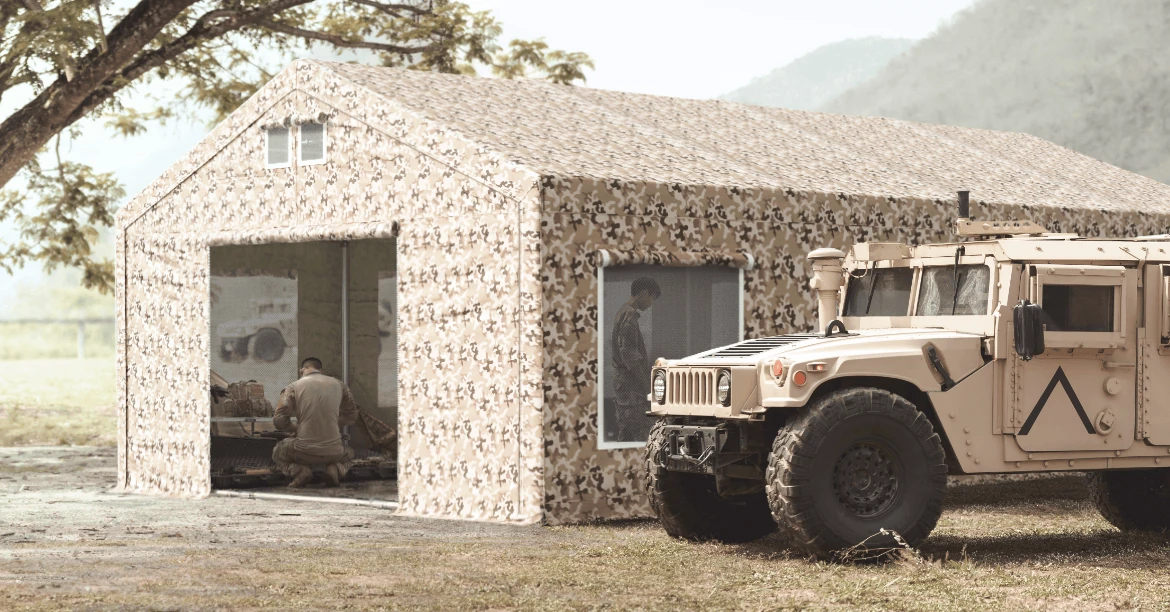
During training ground the moro military tent can serve as an organizational base for staff and exercise participants. Under the roof, you can prepare a check-in desk, lay out maps and training materials, keep documentation and discuss the course of completed tasks. With a larger number of participants, a camouflage tent can be a gathering point before going out into the field and a place for a short rest between training stages.
Military tent can also be used as a sheltered area for equipment used during exercises: backpacks, transport boxes, means of communication, spare clothing or instructional materials. Separating such facilities makes it easier to sort out equipment, hand it out and check it after the classes. You can also prepare equipment sets for individual groups, maintaining free passage and access to the entrance.
Scout tent for bivouac and camp
Moro scout tent can serve as a warehouse for camp equipment, an organizational point or a common space for troops. Under the roof you can store backpacks, canteens, ropes, pioneering tools, materials for classes and equipment needed during field games. It is also a place where the staff can prepare a daily plan, distribute tasks and brief the troops.
During the camp a tent for scouts will work well as a covered common room: a space for meetings, workshops, learning knots, preparing route maps or summarizing field games. In case of rain, it allows you to continue classes, and on sunny days it gives participants a place to rest in the shade. It can be placed at the parade ground, near the sub-camp or as a back-up checkpoint along the rally route.
Fishing tent and base for a carp trip
Above the fishing spot moro fishing tent can serve as an equipment base and a common space for several people. Under the roof you can prepare baits, mix bait mixtures, assemble sets and organize accessories before leaving for the site. There is space for fishing rod cases, landing nets, carp mats, buckets with bait, bags, chairs and spare clothing. Thanks to this, the necessary equipment is at hand and it is easier to keep the waterside sites tidy.
During several days of sessions, the camouflage carp tent can serve as a common space next to smaller roofs placed next to the fishing rods. Anglers can rest there between bites, prepare a meal and store the equipment they use in rotation. Windows with mosquito nets allow you to ventilate the interior when there are a lot of insects, and lowerable blinds protect it against cold wind and moisture in the evening. Green camouflage fits well with the surroundings of reeds and trees, while sand camouflage suits light, sandy shores.
Camo tent for a paintball field
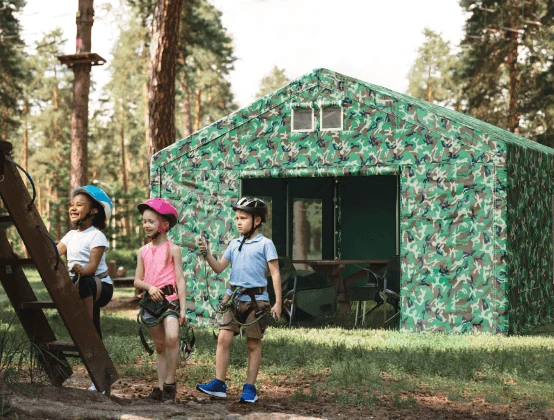
On the paintball field, a camouflage tent can serve as a registration point, briefing place and facilities for players between games. Under the roof, you can prepare an area for markers, masks, protectors and other paintball equipment. A paintball tent can also be used as a tournament support base or a place to hand out equipment before entering the field. The green camouflage tent is suitable for a forest paintball field, and the sand one for an area with light, dry ground.
Survival tent and bushcraft base
Tent for field games and military events
A tent for field games can be a team base, a participant registration point, a check-in place or an organizers' stand. At ASG, paintball and reenactment events, the camouflage military tent helps maintain a consistent visual setting and at the same time provides space for equipment and preparations before the game. A camouflage tent can also mark a control point or technical facility along the game route.
Off-road tent for rallies and road trips
During off-road expeditions, a camouflage tent will work as a base, a shelter for equipment and a place to plan the further route. It can be used by the team during a rally, a cross-country rally or a multi-day field trip. A camouflage tent placed at the expedition base provides additional space outside the vehicles, useful for organizing tools, parts and luggage. When choosing the size, you must take into account the number of people, the amount of equipment and the free space needed to move around comfortably inside.
Camouflage tent for training and outdoor events
Moro tents can also be used by organizers of outdoor first aid courses, nature workshops, outdoor competitions and military-themed events. Moro field tent can be an information point, a cover for training materials or a service base.
Which camouflage tent should you choose?
When choosing a camouflage tent, it is worth matching the camouflage color, size and type of structure to the place and method of use. For short, seasonal activities, you can choose the seasonal version; If you plan to use it all year round, the all-season version will be suitable. Check the available sizes of camo tents and choose a variant suited to your field base.
FAQ
What can a camo tent be used for?
A camo tent can be used as a covered space during military training, scout camps, survival expeditions, fishing trips, paintball games, ASG events and off-road expeditions. Depending on the needs, it can serve as an organizational base, an equipment warehouse, a check-in point or a common space for participants of field activities.
What color of the camouflage tent should you choose - green or sand?
The color of the camouflage tent should be matched to the environment in which it will be used. Green camouflage works best in forests, grassy areas and among vegetation. Sand camo will be a suitable choice in dry, sandy areas and in bright landscapes. Both color variants make it easier to visually match the roof to the surroundings.
Are camo tents waterproof?
Yes. The covering of camouflage tents is made of 600D Oxford fabric protected from the inside with a PVC layer, which makes the material waterproof. Thanks to this, the camouflage tent can create a sheltered space during rain, helping to protect users and stored equipment from precipitation.
Can a camouflage tent be used all year round?
Yes, provided you choose a model equipped with a structure intended for year-round use. Camo tents are available in both seasonal and year-round versions. Seasonal models will be useful primarily for activities organized in the warmer months, while year-round structures are intended for use regardless of the season. In each case, it is necessary to anchor correctly and follow the rules of safe operation.
Does the camouflage tent have windows and ventilation?
Yes. Camo tents are equipped with windows with mosquito nets and foldable blinds. Mosquito nets allow air to flow and limit the entry of insects into the interior, which is especially useful during camping, fishing trips or scout camps. If necessary, the blinds can be lowered to additionally protect the interior against wind and precipitation.
Is the camo tent covering flame retardant?
Yes. The camouflage tent cover is made of 600D Oxford fabric with an internal PVC layer and has flame-retardant properties. This is an important feature when organizing field training, camps and outdoor events. However, it should be remembered that flame retardancy does not mean complete resistance to fire, so fire safety rules should be followed during use.
How to choose the size of a camouflage tent?
The size of a camouflage tent should be adjusted to the number of users, the type of planned activities and the amount of stored equipment. If the tent is to serve as an equipment base, it is worth including space for boxes, backpacks, tools and other accessories. If it is used as a check-in point, camp common room or common space, adequate space for participants and free passages must be provided.
Can the camo tent be repeatedly assembled and moved to another place?
Yes. The camouflage tent has a structure that allows disassembly, transport and reassembly in another location. Thanks to this, it can be used during various camps, training, expeditions and field events. This is a practical solution for organizations and people who need covered facilities in changing places.